Marketing Tours
Posted on Jun 24, 2026 4 min read

Posted on Jun 24, 2026 4 min read
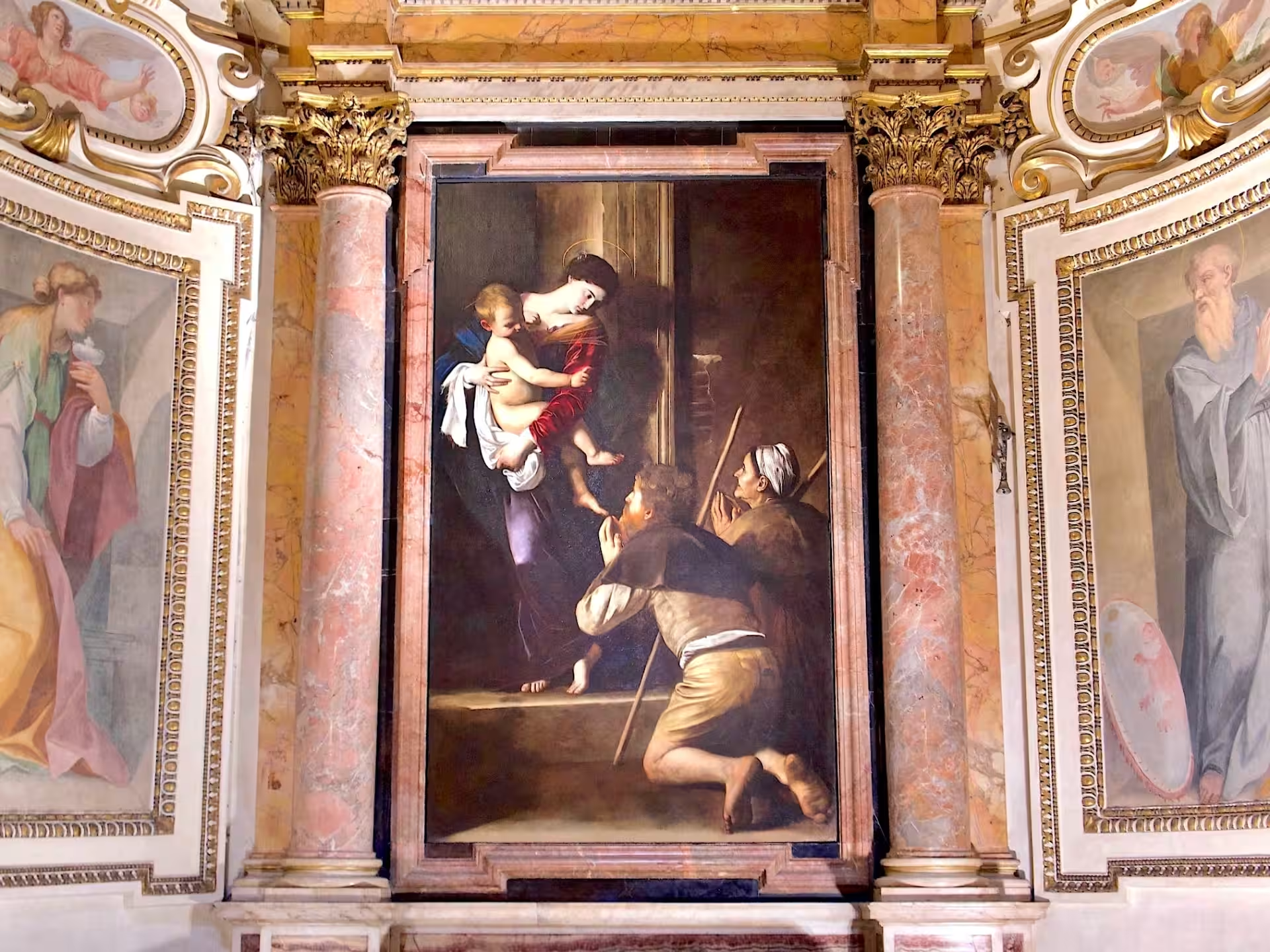
Step into the Basilica of Sant'Agostino and Caravaggio's Madonna di Loreto (also known as Madonna dei Pellegrini) doesn't greet you with spectacle. No angels flying overhead, no golden glow, no heavenly drama. Instead, it's almost disarmingly simple: a doorway, two pilgrims, and a woman holding a child.
That simplicity is the shock. Caravaggio takes one of the most miraculous Marian legends and strips it down to something immediate, grounded, and startlingly close.
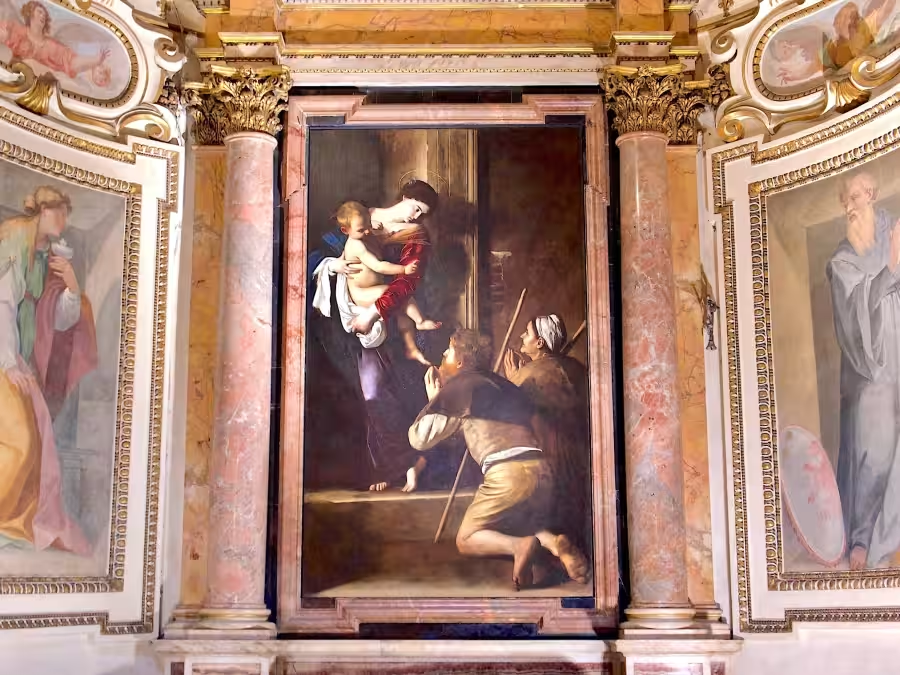
What you’re looking at are two pilgrims arriving at the Santa Casa: the Holy House of Loreto, believed to be the home where the Virgin Mary lived in Nazareth. According to tradition, the house was miraculously moved by angels in the late 13th century, carried from the Holy Land to Croatia, before eventually arriving in Loreto in Italy to save it from destruction as the Holy Land fell.
Artists loved this story, and they usually painted the miracle itself: the house in flight, angels carrying it through the sky, the Madonna and Child shown inside or above it, surrounded by celestial drama.
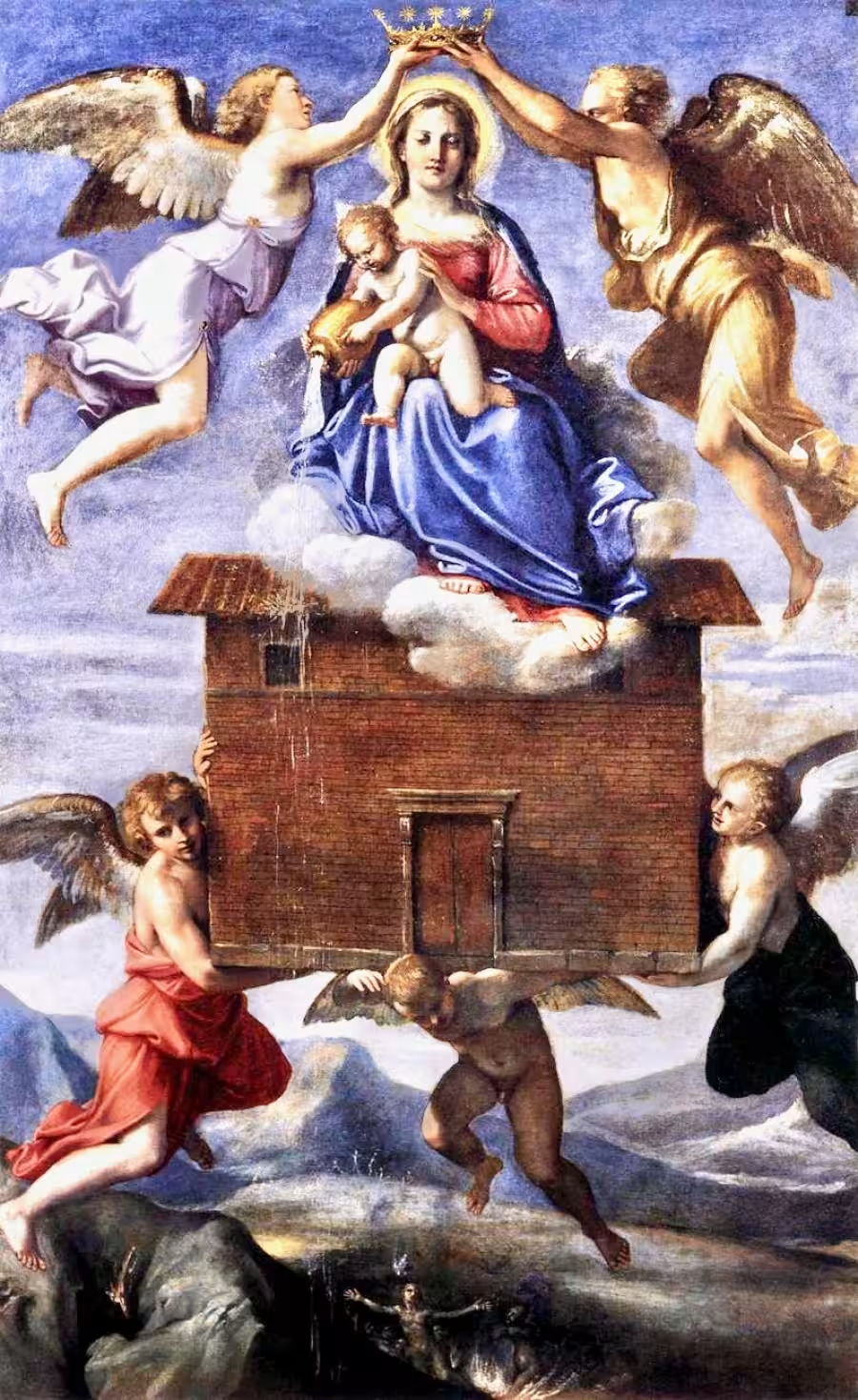
Image credit: Workshop of Annibale Carracci, Translation of the Holy House, c. 1604-1605, Sant'Onofrio al Gianicolo, Rome. Public domain, via Wikimedia Commons. Original source: Web Gallery of Art.
This is why Caravaggio’s version feels so different. Compare it with Annibale Carracci’s Translation of the Holy House, painted almost at the same time. There, the house soars through the air, lifted by angels, full of movement and energy. In Caravaggio’s, there is no flight at all. No angels, no spectacle. The house becomes a plain brick structure, solid and still, with the Virgin standing in the doorway. The miracle is no longer distant and airborne - it has been brought to earth.
At the doorway stands the Virgin. She isn’t enthroned, floating, or wrapped in untouchable glory. She stands barefoot on the threshold, holding the child. Her red and blue clothing still hints at her sacred identity, but the effect is strikingly human. She feels present, physical - less like a queen of heaven than a woman you could almost meet in the street.
That’s where Caravaggio pushes things further than people were used to at the time. By the early 1600s, artists had already moved far beyond the rigid figures of the medieval period - think of Cimabue’s Maestà, where the Madonna appears distant and untouchable. The Renaissance had brought more movement and emotion, making figures warmer and more alive. But Caravaggio goes further. He doesn’t just humanise the divine, he removes the distance altogether.
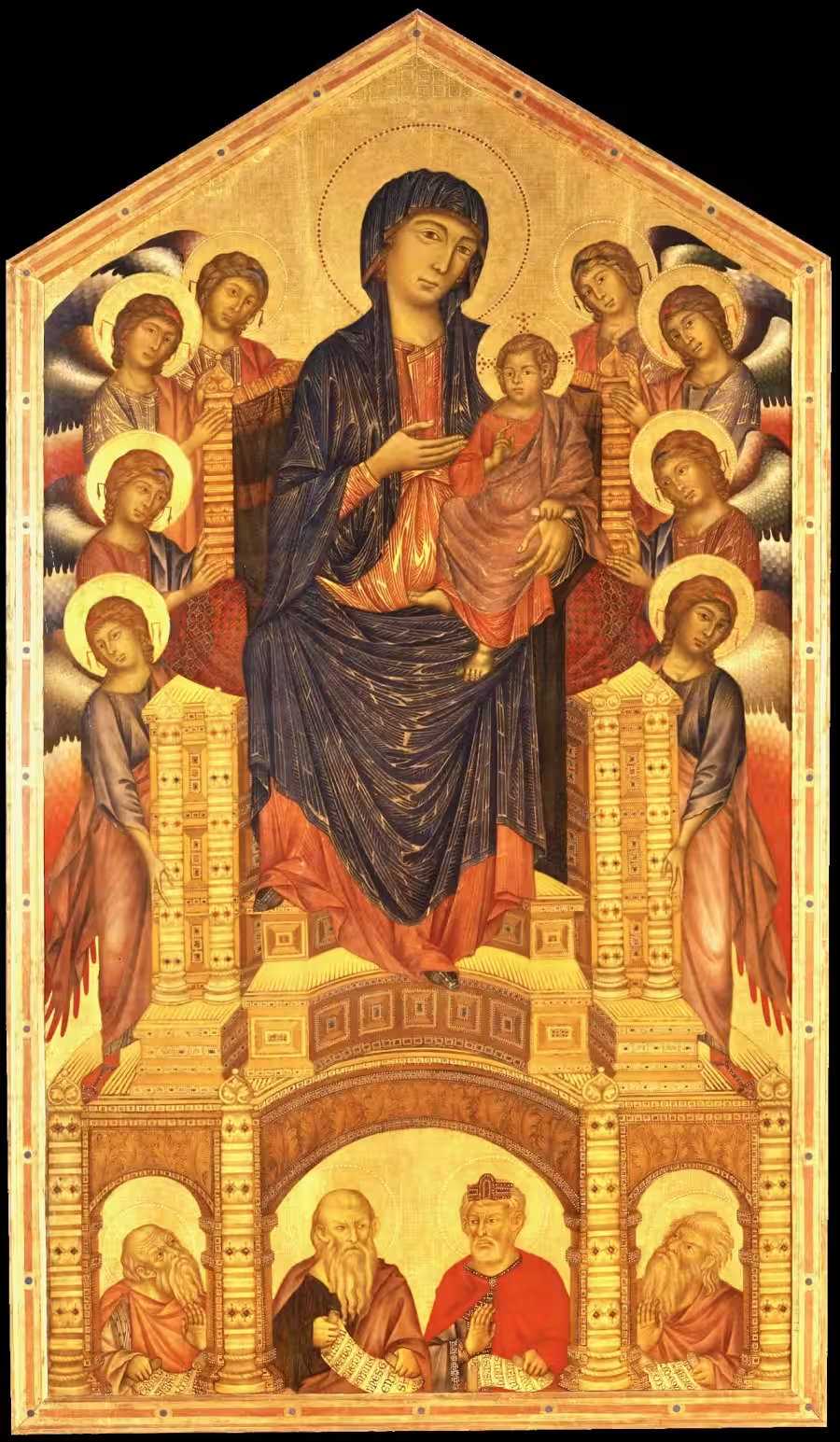
Image credit: Cimabue, Madonna and Child Enthroned with Angels and Prophets (Santa Trinità Maestà), c. 1290-1300, Uffizi Gallery, Florence. Public domain, via Wikimedia Commons.
The pilgrims reinforce that shift. They kneel in front of her with bodies that feel heavy from the road, hands clasped, faces marked by fatigue and devotion. And their feet - bare, dirty, worn - carry the physical reality of pilgrimage into the painting. He doesn’t idealise them, instead he lets them remain what they are: ordinary people who have arrived before the sacred.
When the painting was unveiled, it caused an uproar. The dirty feet played their part. So did the plain doorway, the lack of grandeur, and the fact that Madonna seemed to resemble a real Roman woman - possibly Maddalena Antognetti, known as Lena, someone connected to Caravaggio’s own life.
But the real scandal was the closeness. The Virgin looked like a common woman, the pilgrims looked too real, the miracle felt too ordinary. Caravaggio collapsed the distance that earlier artists had carefully maintained: the sacred was no longer elevated above the faithful, but standing directly in front of them.
And yet, the painting was not rejected. It remained in Sant’Agostino. Many people were deeply moved by it, precisely because it made devotion feel immediate and human. In that sense, it fit perfectly with the spirit of the Counter-Reformation, which encouraged sacred art that people could connect with directly.
And it still works that way today. Stand in front of Madonna di Loreto and it doesn’t overwhelm you through spectacle, it pulls you in through details: the brick doorway, the Virgin’s bare foot, the pilgrims’ worn soles.
Caravaggio doesn’t make the sacred less powerful, he makes it feel closer.
Want to see it in person, understand the stories behind it, and discover more of Caravaggio’s masterpieces in Rome’s churches? Join our Caravaggio churches tour.