Marketing Tours
Posted on May 25, 2026 4 min read

Posted on May 25, 2026 4 min read
While crowds pack the Colosseum and queues spill through the Roman Forum below, Trajan’s Markets often remain surprisingly calm, despite sitting just a stone’s throw away. And yet, this is one of the most immersive ancient sites in the city.

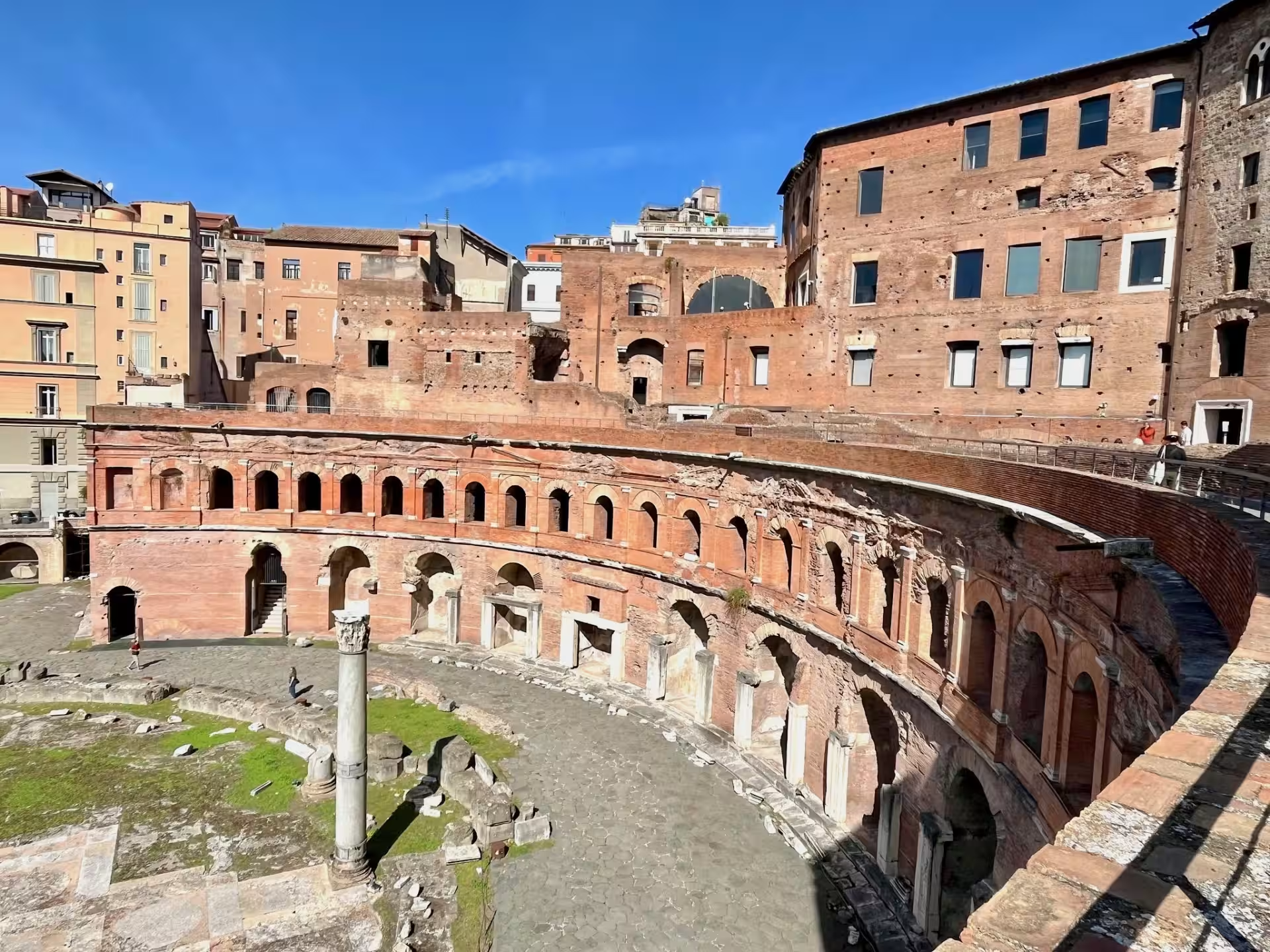
You walk through intact brick corridors, step inside ancient shopfronts, climb staircases between multiple levels, and suddenly find yourself moving through spaces that are still easy to make sense of today. The streets feel like streets, the shopfronts still look like shopfronts: instead of trying to mentally reconstruct scattered ruins, ancient Rome unfolds around you here.
Built in the early 2nd century AD under Emperor Trajan, the complex rises directly into the slope of the Quirinal Hill as part of the wider transformation of this area, including Trajan’s Forum - the last and largest of the Imperial Forums in Rome. The entire project was shaped by the architect Apollodorus of Damascus, one of the great engineering minds behind Trajan’s vast building program.
To create the complex, the hillside itself was cut back and reshaped, making room for a layered network of streets, vaulted halls, staircases, and terraces stacked across multiple levels. Despite its name, these were not simply rows of market stalls. The complex likely combined shops, storage spaces, offices, and administrative rooms tied directly to the functioning of Trajan’s Forum next door.

What survives today is a largely intact skeleton of that system. Walking through the layered brick spaces and arched shopfronts feels surprisingly modern, and it becomes easy to understand why Trajan’s Markets are often described as “the world’s first shopping mall” - even if the reality is a little more complicated.
Many ancient sites can feel a bit like homework: you stare at broken columns, half walls, and tiny site maps trying to imagine what used to stand here. Trajan’s Markets are different: here, the architecture does a lot of the work for you.
One staircase pulls you upward, a corridor opens into a vaulted hall, and then another terrace opens above the forums. There is no single rigid path through the complex, which is part of what makes it so enjoyable. The whole place invites you to wander, climb, peek around corners, and see where the next staircase leads.

And as you move through the spaces, ancient Rome starts feeling far less distant. Even two thousand years later, the layout still feels familiar, and the scale remains surprisingly human. Rather than observing ruins from the outside, you move through them naturally.
That’s what makes Trajan’s Markets feel so immersive: not the spectacle of emperors and gladiators, but the rhythm of a functioning city - merchants selling goods, officials moving between offices, and people climbing the same staircases you’re walking today. And despite sitting beside some of Rome’s busiest landmarks, the markets stay blissfully calm. No packed pathways, no constant flow of tour groups - just space to wander and absorb the place at your own pace.
One of the best surprises comes when you reach the upper terraces. The complex opens outward, revealing sweeping views across the Imperial Forums and the city beyond: ruins, umbrella pines, domes, bell towers, and modern streets all layered together in that unmistakably Roman way.

From up here, the whole area starts falling into place. You begin to understand how the Forums connect to one another, how Trajan’s Markets fit into the wider imperial landscape, and just how enormous this part of ancient Rome once was. And because the terraces are usually so quiet, it’s easy to stop for a moment and properly take it all in.
Trajan’s Markets don’t overwhelm you through spectacle. Instead, they pull you in through movement, space, and the strange feeling that ancient Rome suddenly isn’t quite so hard to imagine anymore.
If you’d like to experience the site with all its stories, layers, and hidden corners brought fully to life, our guided tour explores the complex level by level, uncovering how this remarkable part of ancient Rome actually functioned.